
Dish
By Nancy Jo Cullen
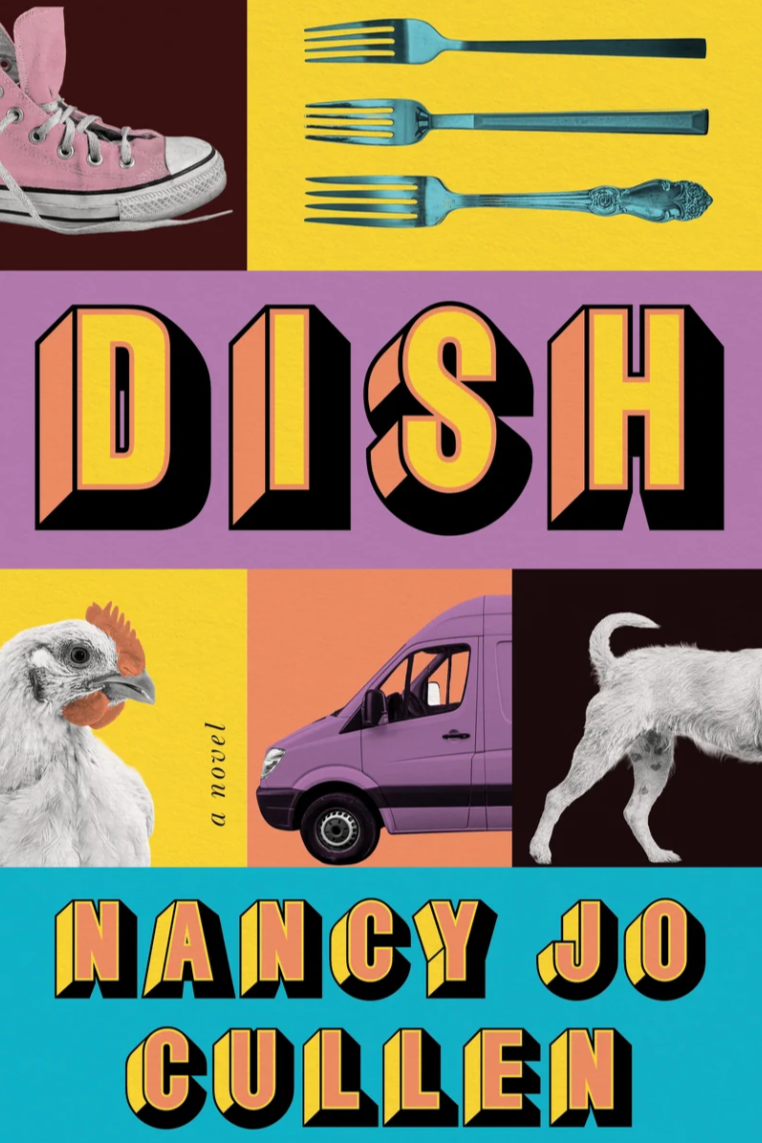
Dish is a fun, engaging, and thought-provoking novel about relationships, second chances, and the complexity of love in all its forms. One of the central characters is Frida, a woman who returns to her hometown in BC after she’s forced to sell her popular restaurant in Toronto. She returns to live with her two mothers, as well as Perry, the sperm donor that has accepted help from her parents after a series of his own struggles. On her return, Frida finds herself employed at the same restaurant as her ex-fiancé, Charlie, the man she thought she’d gotten over. But both Frida and Charlie find that sometimes, it can be hard to quit another person, no matter how hard you try.
At its core, this novel is a romance. Although I don’t typically read this genre, Dish offered such a myriad of fresh perspectives that I’ll be thinking about these characters for a long time. This is not a simple hetero-normative relationship, nor is it nestled in hetero-normative culture. Raised by a lesbian couple and conceived by the donated sperm of a gay man, Frida’s entire upbringing is shaped by the queer community. Frida is also, herself, bi. Charlie, on the other hand, was raised in the precise opposite environment, and the past behaviour of his parents, and Charlie’s acquiescence to it, is central to the struggles that Charlie and Frida face.
One of the strengths of this novel is the balance that Cullen manages to strike in representing the normalcy of queer relationships (in other words, not strictly trauma based), and the resistance and questioning that still exists in society at large. While Charlie’s mother dismisses her own daughter’s queerness as attention-seeking, and presses Frida for which of her mothers is the “real” mother, Cullen also brings into focus the inner workings of Frida’s childhood home, an environment characterized by confidence, safety, love and stability.
In addition, Cullen offers a number of nods to the social conditions that have shaped her characters, such as the people Perry lost during the AIDS epidemic, the consequences of the pandemic, and substance abuse issues. These are mentioned and explored, though lightly, just a soft sprinkle of the heaviness of the world in an otherwise fun and appealing novel about love, passion, and the process of growth in an ever-changing world.
As Frida’s friend and sponsor points out: “But you’re alive, Frida, so I promise you that you are going to mess up again. Whether this situation is a mess or not remains to be seen. But you’re imperfect and you always will be. And that’s actually fine.”